

Abstract
Quantum Grade Diamonds (QGD) are ultra-pure synthetic diamonds engineered at the atomic scale to host quantum defects—specifically nitrogen-vacancy (NV) centers—critical for next-generation quantum technologies. This whitepaper outlines their material properties, fabrication techniques, quality benchmarks, and applications in quantum computing, sensing, communications, and navigation. It further compares QGD with alternative materials and provides insight into current industrial adoption and future prospects.
1. Introduction
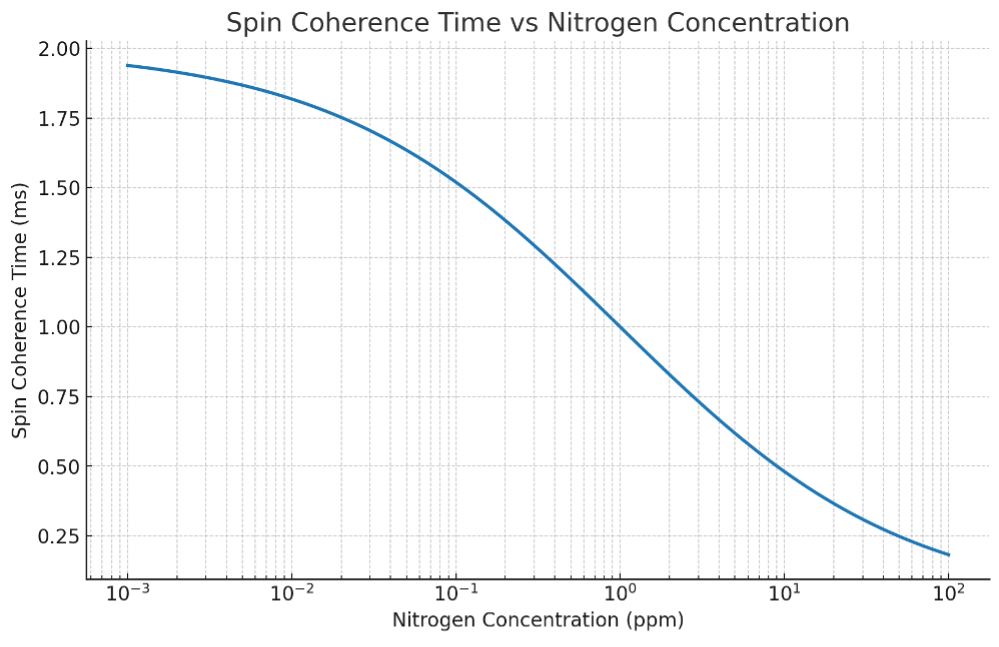
At the forefront of the quantum revolution, Quantum Grade Diamonds stand out as a unique enabling material. Unlike natural or industrial-grade diamonds, QGD substrates are fabricated with precision nitrogen control and ultra-low impurity levels, delivering superior spin coherence times required for scalable quantum devices.
Diagram Suggestion: Schematic of an NV center in diamond lattice showing substitutional nitrogen atom adjacent to a vacancy.
2. Definition and Characteristics
1 Definition
Quantum Grade Diamonds are synthetic diamond substrates with nitrogen concentrations tunable from 1 part per billion (ppb) to 200 parts per million (ppm). They are specifically designed to host and manipulate NV centers.
2 Key Properties
Table 1: Key properties of Quantum Grade Diamonds.
| Property | Value/Range | Measurement Technique | Relevance to Quantum Applications |
| Nitrogen concentration | < 5 ppb – 200 ppm | SIMS, FTIR | Coherence control, defect tuning |
| Spin coherence time (T₂) | > 2 ms (room temp) | ODMR | Qubit stability |
| NV⁻ yield in doped regions | > 90% | Confocal microscopy/ODMR | Photon emission efficiency |
| Homogeneity | ≤ 5% surface variation | FTIR mapping | Reproducibility in devices |
3. Fabrication and Engineering
- Ultra-Pure Crystal Growth: CVD with controlled gas purity ensures nitrogen below 5 ppb.
• Tunable Doping: Nitrogen introduced in calibrated ranges, enabling tailored performance.
• Advanced Structuring: Subsurface NV networks, 3D stacks, and buried layers integrated into photonic and electronic devices. Diagram Suggestion: Layered structure of engineered diamond with buried NV centers and waveguide integration.
4. Applications
1 Quantum Computing
NV centers act as spin-based qubits with long coherence times. Scalable architectures leverage diamond’s durability and stability.
2 Quantum Sensing and Magnetometry
Biomedical: Mapping magnetic fields within living cells.
Defense: Navigation systems immune to GPS jamming.
3 Secure Quantum Communications
QGD substrates produce reliable single-photon sources essential for quantum key distribution (QKD) networks.
4 Aerospace and Space Applications
NASA and defense agencies are evaluating diamond-based gyroscopes and navigation systems for spacecraft resilience.
Table 2: Applications of Quantum Grade Diamonds.
| Sector | Use Case | Advantage of QGD |
| Computing | Spin-based qubits | Long coherence times |
| Healthcare | Nanoscale magnetic imaging | Non-invasive, ultra-sensitive |
| Defense | Quantum navigation systems | GPS-independent, robust |
| Telecom | Quantum-secure communication | Reliable single-photon sources |
| Aerospace | Spacecraft gyroscopes | Noise-resistant, durable |
5. Comparison with Other Materials
Table 3: Material comparison.
|
|
|
|||
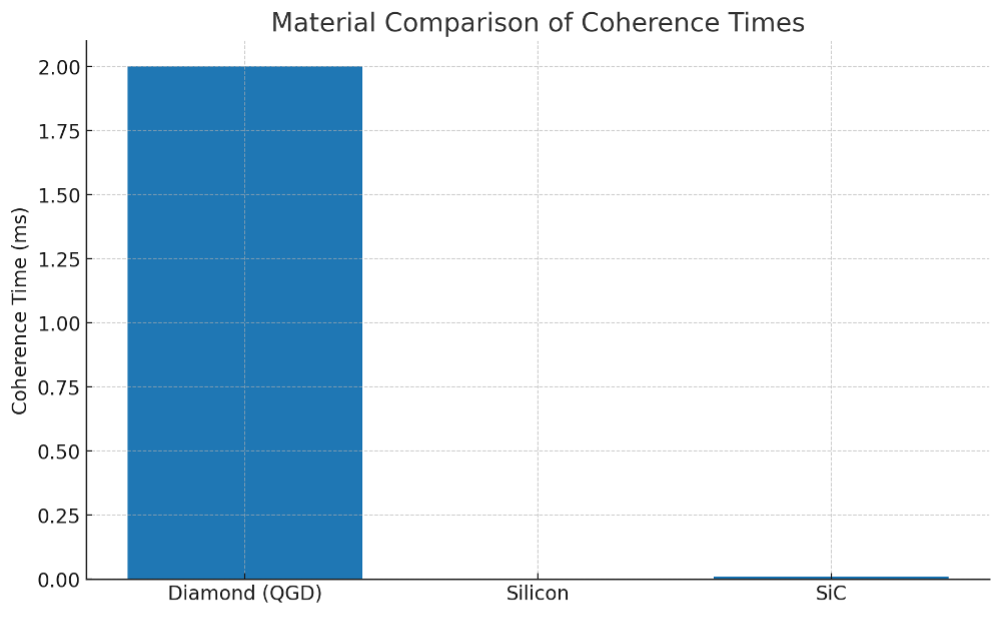
| Diamond (QGD) | Ultra-high purity, long coherence, tunable | Cost, fabrication scalability | |||
| Silicon | Mature semiconductor platform | Poor coherence times | |||
| Silicon Carbide | Established defect control | Limited purity vs diamond |
6. Quality Validation
Each QGD substrate undergoes strict testing:
• FTIR & ODMR to confirm nitrogen levels.
• Homogeneity Mapping ensuring ≤ 5% variation.
• NV⁻ Yield Analysis exceeding 90% in doped zones.
7. Future Outlook (2025–2030)
Quantum Grade Diamonds are projected to underpin major advances in defense, healthcare, space, and computing. Challenges remain in cost reduction and scalable production, but ongoing research is addressing these barriers.
8. Conclusion
Quantum Grade Diamonds are more than materials—they are the core enablers of the quantum era. With unmatched stability, tunability, and resilience, they are poised to become the backbone of quantum computing, sensing, and communication technologies.
