
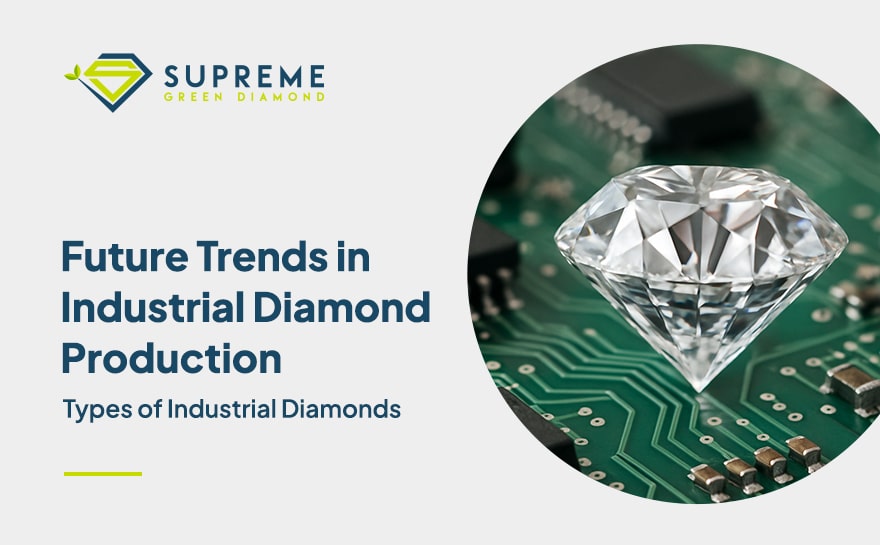
In today’s fast-growing technology-driven world, the demand for industrial diamonds is rising rapidly. No longer limited to traditional cutting and drilling tools, industrial diamonds are now essential for high-tech, luxury, and advanced applications.
From optical-grade diamonds in precision lenses to electronic-grade diamonds in high-performance electronics, the industry is evolving fast. Understanding these emerging applications offers insight into how industrial diamond production will shape the future of modern industries.
What Are Industrial Diamonds?
Unlike gemstones used in jewelry, industrial diamonds are valued for their exceptional physical properties. They are critical in industries that require hardness, heat resistance, or unique electronic properties.
Types of Industrial Diamonds
– Optical Grade Diamonds: Superior clarity and light transmission for lenses and precision optical instruments.
– Electronic Grade Diamonds: Excellent heat dissipation and insulating properties, ideal for electronic devices.
– Mechanical Grade Diamonds: Extreme hardness and durability for cutting, grinding, and drilling.
– Thermal Grade Diamonds: Exceptional thermal conductivity for use in heat spreaders and thermal management.
– Quantum Grade Diamonds: Emerging class of diamonds with unique quantum properties for quantum computing and sensing applications.
The Rise of Lab-Grown Diamonds
A major trend shaping the industry is the growth of lab-grown diamonds, produced using methods such as Chemical Vapor Deposition (CVD). These diamonds are:
– Highly Pure: With fewer defects, making them suitable for advanced technologies.
– Customizable: Engineered for specific applications, from electronics to optics.
– Eco-Friendly and Cost-Effective: Offering a sustainable and affordable alternative to mined diamonds.
Examples include:
– CVD Diamonds: High-purity diamonds created layer by layer, tailored for high-tech industries.
– Nitrogen-Free Diamonds: Especially critical for electronics, where even tiny impurities can impact performance.
As lab-grown diamond technology advances, production is becoming faster, cheaper, and more scalable, accelerating adoption across industries.
Applications in High-Tech and Luxury Sectors
High-Tech Applications
– Diamond Heat Spreaders: Improve thermal management in electronics, extending device performance and lifespan.
– Boron-Doped Diamonds: With unique conductive properties, they enable innovations in high-power electronics and semiconductor devices.
Luxury and Fashion
– Gem-Quality Lab-Grown Diamonds: Increasingly used in watches, accessories, and fine jewelry.
– Functional Luxury: Diamonds that combine beauty with advanced performance are meeting the demand for eco-conscious, tech-inspired luxury products.
Challenges and Opportunities
Challenges
– Production Costs: While cheaper than mined diamonds, setting up production still requires major investments in technology.
– Market Competition: With more players entering the industry, innovation and differentiation are crucial.
Opportunities
– Sustainability: Eco-friendly diamond production appeals to socially and environmentally conscious consumers.
– Advancing Technology: Continuous improvements are reducing costs and enhancing quality, opening doors to wider industrial adoption.
Future Outlook
The future of industrial diamond production looks exceptionally promising:
– Wider Adoption of Lab-Grown Diamonds: Growing focus on sustainability and cost efficiency will drive demand.
– Quantum Technology Expansion: Quantum-grade diamonds will play a vital role in quantum computing and sensing.
– Integration with Emerging Tech: Industrial diamonds will increasingly support advanced electronics, medical devices, and other next-generation technologies.
Conclusion
Industrial diamonds are evolving beyond traditional applications to become central to technology, luxury, and innovation. With the rise of lab-grown diamonds and their expanding uses in high-tech and luxury sectors, the potential for growth is immense. As industries continue to innovate, industrial diamonds will remain at the forefront of progress in both technology and design.
FAQs
1. What are industrial diamonds and how are they used?
Industrial diamonds are non-gem diamonds used in electronics, tools, thermal systems, and advanced technologies for their hardness, thermal conductivity, and insulating properties.
2. What are the different types of industrial diamonds?
Optical, electronic, mechanical, thermal, and quantum grades, each serving specialized purposes.
3. What are lab-grown diamonds and why are they important?
Lab-grown diamonds (CVD, nitrogen-free) are customizable, sustainable, and cost-effective, making them essential in high-tech industries.
4. How are industrial diamonds used in high-tech and luxury industries?
They are used as heat spreaders, in semiconductors, and in eco-friendly luxury products like watches and accessories.
5. What does the future look like for industrial diamond production?
The industry will grow rapidly with wider use of lab-grown diamonds, applications in quantum computing, and integration into advanced technologies.
